Showing posts with label #Marathon #BostonMarathon. Show all posts

Saturday, September 24, 2016

Tunnel Lite Marathon Race Report


It's been an incredible year of training and racing in celebration of turning 50 last December. Last Sunday's Tunnel Lite Marathon concluded a 12 month stretch that included three full marathon training cycles (December 2015 Honolulu Marathon, April 2016 Boston Marathon and the September 2016 Tunnel Lite Marathon),  two half marathons (Rain Day Half January 2016 and Seattle Rock-n-Roll Half June 2016) as well as the Ragnar Relay in July (Sub-Masters team win) and an 8K and 5K for good measure.  In total the last 52 weeks of training was just short of 2000 miles at 1940 total -- which included limited mileage in the winter due to a nasty lower right leg tendon injury I fought from February through April.    Suffice it to say that my run last Sunday was coming on tired mind and body -- knowing full well that I'd also managed to hit peak fitness/speed sometime in late July and was starting to fall off my top training times and heart rate levels.    
Somewhere around mile 15 of the Tunnel Lite Marathon.  My quads were starting to take a real beating from the downhill here as I passed the photographer trying to look strong and knowing I had another 10 miles in front of me.

I loved this marathon for its beauty, simplicity and that it was just 600 total runners and executed like a finely oiled machine.  And lest I forget the primary selling point -- it's a 2000', vertical drop for 23 miles or about a negative 1.6% to the finish line just east of North Bend, WA from mile 3.    The other main feature of this race is that at about the 1/2 mile mark, you enter into an old railroad tunnel that is devoid of light (other than hundreds of headlamps and flashlights) through which we ran 2.3 miles to the light (hence the name of the race -- "Tunnel Lite Marathon").     My goal was to run a sub 3:30 BQ here and get back to Boston for 2017 (as the race fell right in them middle of the 2017 Boston Marathon entrance window) -- but realistically I knew that I had peaked a few weeks earlier and had been suffering the last month or so from some cumulative fatigue that had set in which would make a great time on this downhill track an uphill challenge.   I was however resolved to see if I could dig it out and decided to run an aggressive opening half to see if I could hang on over the back half of the race.
It was nice simply getting up around 4:30 AM for an 8:00 am race time, fueling about 150 grams of carbs which included a "roadie" smoothie" -- and driving the 25 miles on the freeway to the bus pick-up point just east of North Bend.     I parked my car in a non-descript parking lot before sunrise and simply walked over to a waiting yellow school bus which in turn took off and drove another 25 miles or so eastward up and over Snoqualmie Pass to Hyak (just short of Keechelus Lake) off Interstate 90.
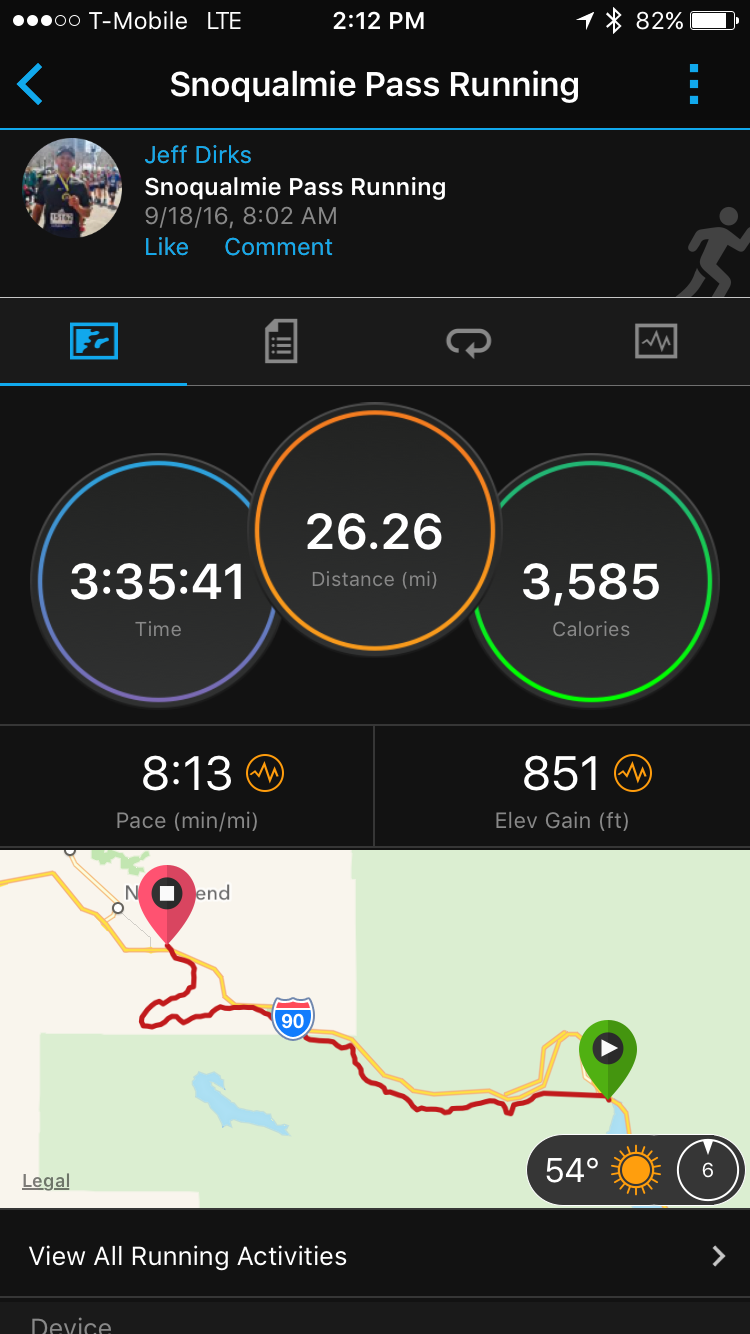
Of my 9 marathons, this was my 3rd fastest time -- and easily the best racing weather I've experienced.  7 of my 9 marathons have featured simply terrible to non-ideal weather so it was great to catch a weather break this time.
In terms of racing strategy, if I was going to run below 3:30:00, I believed I had to get out strongly and take advantage of the downhill, building a time buffer and then hold on over the last 5 miles -- ideally running 8:00 pace or at least nothing slower than 8:20's for the final 5 miles.    

The terrain for the course was a converted railroad track that was mostly compact dirt and rocks becoming gravel over the latter stages of the course.    Nearly half of my training this last year has been on the Cross Kirkland Corridor trail which is also a converted railroad track composed of soft gravel and compact dirt - so I felt comfortable that I'd be fine on the terrain.     As it turns out, the first 10 miles of the trail was actually quarter or larger sized rocks, some gravel, dirt and smaller ruts and undulations -- that were easy to navigate -- but really made the run more jarring on the quads.   I knew was going to be a problem later in the race (in comparison, running on a smooth asphalt or gravel trail is less jarring and one is able to glide and be more economical with muscle movement which conserves energy that's required for the last 5-6 miles of the marathon).    

I got through the first 5 miles (which included the 2.3 mile jaunt through the tunnel which was a little harder to run quickly than anticipated) in 7:46 pace and 38:51 and 10 miles in 77:38 and 7:45's.   At mile 10 I was feeling a lot more quad weariness than I expected (it felt like I'd already gone through 18 miles or so in fact) from the jarring but I was able to press on and get to the half marathon point in a great time of 1:41:30 and 7:46 pace.   I was right on my race strategy and within 7 seconds per mile pace of my PR at 3:20:00.    However, the quad soreness and fatigue was mounting and I knew I had to back it down a bit.   

At mile 14 I had been running with a group of men all shooting for sub 3:25:00.  We were running comfortably for 10 or so miles together, chatting and just getting into the groove as the miles passed by.   However, I stopped to walk the water station before mile 14 to see if I could gather a bit and decrease the quad fatigue before resuming running -- cutting my pace back to around 8:00 or even a little slower as I had a good buffer of time built up.    I ran miles 14 - 20 in about 50 minutes or 8:17 pace and got to mile 20 in just under 2:40:00 (which is 8:00 pace).   I was still in the game late in the race for a BQ -- if I could simply just muster and rally through the quad fatigue.    In my training in the summer,  I consistently ran fast-finish long runs where I'd cut-down miles 16 - 22 below 8:00 pace and even miles 21-22 in around 7:40 pace to practice for this exact moment.      

But the downhill grade was really starting to take a toll on me.   I slowed running mile 21 in 8:36 and then the dreaded 9:00's set in and I ran 9:15, 9:11, 8:55, 9:16 and 9:05 in (20-30 seconds of each mile was walking trying to re-focus and then rally to something below 8:00 pace).  But as the final miles clicked off I realized I was out of reach of a BQ and I relaxed and got through to the finish line in 3:35:39.     I was very very pleased with my race outcome given the fact that I'd peaked in late July, been feeling run-down the last 6 weeks but still at mile 22 had a 3:30 in my gun sights.  

I also realized on the back half of the race that racing Boston in 2017 would require me to get back into marathon training in early January which felt overwhelming giving I've come off 3 races in 9 months and 5 marathons going back to Portland in October 2014 over 23 months.  

My opening half was 1:41:30.  I then faded running the concluding half in 1:54:00 or so which is a large positive split -- but I made a conscious decision to go out hard and try to hang on -- and this is the sort of thing which happens with aggressive race plans.   I wanted to win big or blow up trying. I had nothing to lose anyway, right?    

Subject to my next blog posting -- the leg pain from Monday-Thusday this week was incredible.  It didn't help I jumped on an airplane and flew all day Monday morning after Sunday's race, but suffice it to say running a downhill marathon requires a little more specialized training than I anticipated.   

I can't wait to do this race again.  The next running of it is June 2017 and I will be laced up and ready to go!  Can't wait. 

Looking to the SW at sunrise from Hyak.   The full moon is visible through the wispy fog/clouds at 2500' elevation.


Sunrise with a full moon over Hyak at about 7:00 AM.   Pre-race temperatures were in the upper 40's and a little cool -- but absolutely perfect for racing a marathon.

Looking at one of the ski runs at Snoqualmie Pass at about 7:30 AM.

The race route feather 4 high elevation overpasses that were breathtaking. I tried to run as close to the side as I could to see down and distract myself from the growing pain in my quads as I ran towards the finish line which was still some 10 miles away at this point of the race.


Tuesday, April 12, 2016

6-Days and a Wake-up to Boston

I am sure that most veteran marathoners always find the last 5-6 days leading to race morning the least easy to manage although it's the least strenuous physically.    After 14-16 weeks of 40-60 miles a week, we suddenly have extra time on our hands that was otherwise filled with weekly interval, tempo, long and recovery runs.     Instead of days where it's common to burn 1000 or more calories working out, we need to suddenly worry about gaining a few pounds in advance of the race which is also unsettling (and frankly irritating given how hard it is to drop down and into optimal racing weight) as our caloric needs lessen (although my desire to eat seems to rise as a way to heal up and rest my body -- which I generally pay close attention to as it's a natural part of the tapering process).

As a part of the ritual which has been my final week of marathon preparation for a few years, I always pay special attention to visiting my sports-chiro, masseuse and spending extra time staying loose, limber and mobile.   In fact, during my morning session with my sports-chiro, he remarked that 10 other Boston Marathoner's were coming in today for their final tune-ups before departing for Boston later in the week (this alone is remarkable to me given there's that many of us flying out of Seattle to Boston all seeing the same sports-chiro).

A number of people have asked me recently what the hardest part of preparing to run a marathon is (nearly everyone assumes it's the 20+ mile long runs) -- and they are surprised when I respond saying that -- while 20+ mile long runs are indeed grueling -- it's the final 24 hours leading to actually running the race I find the most completely unpleasant.    I'm not sure if others feel this way, but for me the Saturday (or Sunday in the case of Boston) evening and super early 3:00 am wake-ups (often followed by an adventure even getting to the starting line of a major race and then having to manage some sort of bathroom routine with 25,000 other nervous racers) is by far the least enjoyable part of marathoning.  In fact, if it were feasible to just go run the race in the early evening and avoid the 3:00 am pre-marathon wake-up routine and get it over with -- it would be so much more enjoyable (setting aside issues of heat and humidity running later in the day or early evening).    Outside of the Las Vegas Rock-n-Roll Marathon held in November, I'm not sure of any other evening marathon races so it's just the reality of the situation for me that the least fun part of running the marathon comes right immediately before the absolutely most exhilarating part which is running and completing the race.

I expect I'll spend the next couple of days before flying to Boston Friday morning working on my final racing gear checklist, race strategy and about every other contingency I can think of before showing up out in Hopkinton at about 8:00 am Monday morning -- including what to do for 2 1/2 hours while waiting in the Athlete's Village prior to starting the race at 10:25 AM EDT.  

More to follow on what's been a remarkable journey getting back to Boston in 2016.


Sunday, April 3, 2016

Boston Marathon Training -- Week 12 Wrap-up

It's hard to believe that with yesterday's 21.7 mile long run that my training cycle for the 2016 Boston Marathon is nearly complete.   I still have several runs of substance remaining, with a final 12-mile time trial set for this coming Thursday on a flat 2.8 mile run loop around Seattle's Green Lake, but I am otherwise proceeding into taper mode letting my body heal up after what's been nearly continuous marathon training since Labor Day 2015 over 7 months ago.   In fact as I was running yesterday, I realized that since last October 30th, I've done runs of 20 miles or longer 8 times (including the December 2015 Honolulu Marathon) with the Boston Marathon in 2 weeks being my 9th.  

I designed yesterday's run route to try and simulate the Boston Marathon course through the first 22 miles.    If you've been reading my blog posts for this training cycles, you know I've been battling a lower right leg tendon stress injury to my Peroneus Brevis which has taken me out of my normal training cycle that would've included weekly strength intervals (6 x 1 mile, 4 x 1.5 mile, etc.) including virtually no hill training since around week 4.  

I first ran the Boston Marathon in 2012 (qualifying in the 2011 Scotia Bank Vancouver B.C. Marathon with a 3:20:30) on an 88 degree Patriot's Day -- and was absolutely crushed by the heat and then just destroyed over the course of the 4 Newton Hills that begin from mile 16 and end with Heartbreak Hill just past mile 20 finishing in an abysmal 4:27:00.   I'd resolved at the start of this training cycle to incorporate hill intervals as well as hills during the end of a few of my longer tempo and Saturday long runs so as to run the Newton Hills with strength and confidence -- and even more importantly be able to take advantage of the downhill finish from Boston College through the end of the race on Boylston.     Normally, Seattle is such a hilly place to run this wouldn't be much of a challenge, but I found after sustaining the tendon injury that any sort of hill work (uphill or downhill) aggravated my pain so I was forced to run on mostly flat, asphalt surfaces.

The picture below is the elevation map of my course yesterday in Seattle that begun on top of E. Madison (near the entrance to Broadmoor) heading steeply downhill towards the water before making a turn to the south and following Lake Washington 7 miles out to Seward Park and around before heading back and hitting the first 1/2 mile long hill at about mile 14.    The climb back up E. Madison is brutally steep (guessing around 5%) and was nearly 1/2 mile and occurred at mile 16.   I then proceeded to run a brisk downhill into the Arboretum and then climb up through the Interlaken Hills before getting to mile-19 and turning around and hitting the same hills in reverse with the final climb back up E. Madison and into Madison Park at mile 20.    This is about as close as I can get to simulating the Boston Marathon Course.

The Boston Marathon's Newton Hills are as follows: Hill 1: Mile 16 .64 length 2.83% incline; Hill 2: Mile 17.6 .34 length 4.4% incline; Hill 3 Mile 19.3 .47 length 3% incline and Heartbreak Hill 4: Mile 20.2 .48 length 3.96% incline.


Yesterday's run went exceedingly well.  I was a little worried given I'd traveled out to Virginia and back from Monday through Wednesday last week, which most often saps the intensity from any runs that follow for a couple of days.   However, I was able to get onto the Alter-G treadmill Thursday AM (after returning at Midnight Wednesday) and knock a run out that was painful, but got me out of the post-cross-country-flying physical funk which afflicts me these days.

I covered the first 8 miles in 8:17, miles 9-16 in 8:10 before slowing for the hills from miles 17 - 20.5 and a final closing .8 miles in 7:55 pace or so.      After yesterday's run which leaves me completely confident for Boston in 2 weeks as I got through the entire run very comfortably, I believe my strategy for the Boston hills will be to simply run even effort with my emphasis being to accelerate out of each hill into the downhill keeping my leg turnover high.    This takes a huge amount of concentration and commitment during the later stages of a Marathon.  That I was able to do this comfortably yesterday is a good sign for race day.  

This will I will meeting with my running coach reviewing my first draft of my race day strategy and fueling plan.  Once I get through Thursday 12 mile time trial, I will have a final idea on how to approach Boston on April 18 and what my A and B goals are for the race.  Stay tuned.


Lake Washington Blvd looking south and towards the 520 Floating Bridge

Cherry blossoms are in full bloom and made for a vibrant run with nature in full bloom in Seattle.

The hills of Interlaken Park at about mile 19 yesterday.

Mt. Rainier beckons nearly 90 miles away at over 14,416 feet.

Running southbound with Seward Park just off in the distance which is a 2.2 mile loop.


Monday, March 28, 2016

Boston Marathon Training -- Week 11 Wrap-up

Writing this post as I fly east today via Chicago to VA for meetings through Wednesday.   It's always a challenge -- especially late in a marathon training cycle to incorporate in work travel with striking a training balance over the last 2-3 weeks.    I've found over the years that after any flight of more than a couple of hours, my training the next day will be mediocre at best and a slog at worst.     I'm hoping tomorrow and Wednesday to at least get 2 hours of aerobic volume in running on the hotel treadmill -- which is always a hit-or-miss proposition.

Three weeks from right now I should be through my first 5K of the Boston Marathon on April 18.   I'm still working through a lower right leg tendon rehabilitation; but with a lot of PT it appears to be holding up.   This last week I managed to runs of substance on the Alter-g for my intervals and tempo workouts followed by a pair of outdoor runs on Saturday and Sunday that were 10 miles each.   Given I ran 22 miles last Saturday, I normally would've run a 14 on Saturday 3 weeks out but wanted to load up 10 miles on Saturday afternoon and then run a 10-mile cutdown run Sunday early before Easter festivities kicked in.      I felt especially strong on Saturday's run with temperatures in the low 60's, no wind nor rain and running in shorts and a t-shirt.   Rolled 8:20's on a 5 mile out and back tossing in a 7:17 mile-4 and a 7:42 mile 9 for good measure.         Sunday's workout was a cutdown run with a 1 mile warm-up followed by a progression from 8:30 down to miles 8 and 9 at 7:30's pace. As luck would have it, the sky opened up and it was torrential rain (and about 45 degrees) from miles 5 - 7 which slowed me a bit (at one point I could barely see the running path in front of me as I was quickly soaked and chilled to the bone thinking it wouldn't rain on my run).    I managed to dig a little deeper and got miles 8 and 9 down to 7:45 and 7:40 respectively before an easy jog in for mile 10.

While it's too early to predict what time I will run in this year's Boston Marathon (I qualified with a 3:27:30 in the 2014 Portland Marathon), I will say that 44" of rain in Seattle from October through March and training for 2 marathons (Honolulu in December) has prepared me for the absolute worst that Boston has to offer on April 18 (short of a hot day in the upper 80's which is what I got the first time I raced there).    

Stay tuned, the next couple of weeks will be interesting with a final 18-20 mile Boston Newton Hills simulation and a couple of more pacing sessions.

Thursday, February 25, 2016

Boston Marathon Training -- Week 7 Wrap-up

It's hard to believe that week 6 of 14 is nearly in the bag training-wise for Boston 2016.    After averaging about 45 miles a week through week-5 including this training cycle's first 20 miler last Saturday, I decided to back off this week due to a lower right leg muscle/tendon strain from pushing too hard in my track intervals in January and instead focus on core, mobility and aerobic training volume with an easy 14 on Saturday.  

In short the first 6 weeks have really been focused on getting to racing weight (down 11 lbs) and then the final 6 weeks before tapering on strength intervals, tempo runs and fast-finish long runs.     I think it's been a good bet since I raced a marathon mid-December and have a solid training base from the Fall.  We will see on Patriot's Day in Boston.

Fingers crossed the lower right leg muscle/tendon strain abates and I can get back to full speed soon.  It wouldn't be a marathon training cycle if there wasn't some twists and turns along the way.   I truly believe the real story of running a marathon isn't the race itself but how one navigates the twists and turns of 6 runs a week for 14-16 weeks enroute to the starting corrals.   I run 6 days a week for 14 weeks so race day is usually my 84th run.   The real story is all that it took to get to the 84th run on race morning.  

I am hoping to talk more about that in the posts that follow leading to Patriot's Day in Boston.

Sunday, February 21, 2016

My Point of View

Preparing to run and race a marathon has striking parallels to my own professional experiences and lessons from working in the technology industry for the last 25 years in Seattle.   Run Hard is written from the point-of-view that the real story of racing a marathon isn't your finishing time --  it's about what it takes to even make it into the starting corrals on race morning.   Run Hard is my own inquiry into commitment to excellence, perseverance -- and just plain old fashioned grittiness.