Showing posts with label #Running. Show all posts

Sunday, July 17, 2016

WE WON -- Men's Submasters Win at the Ragnar Relay NW Passage


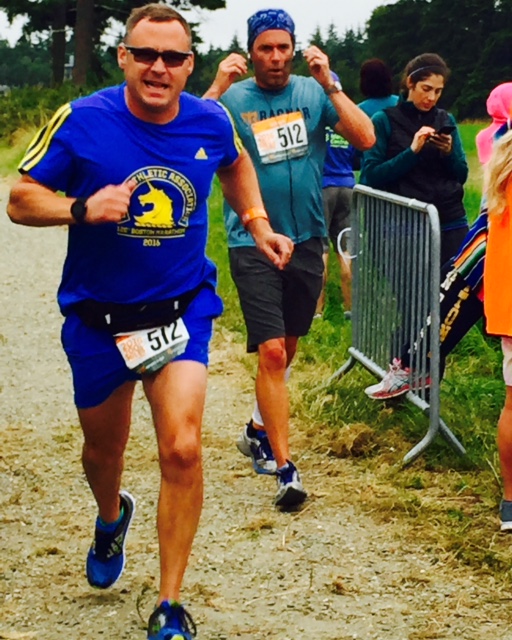
I am proud to say tonight that my son Ethan and I were both members of the winning Men's Submasters team "Sandbaggers" at this weekend's Ragnar Relay Northwest Passage covering 196 hilly miles in 26:00:35 which was 7:55 average pace per mile.
Team Sandbaggers enjoying the ferry ride back from Whidbey Island to Mukilteo after completing the 196 mile Ragnar Relay Northwest Passage.  It was perfect weather for this year's event.
Sandbaggers take first place by over 30 minutes.  The 2nd place team was on the first mile of the 36th and final leg when we crossed the finish line 4 miles ahead.
For anyone not familiar with the format of a Ragnar relay, a team consists of twelve runners who are broken into two vans of six runners each.   The entire relay consists of thirty-six legs beginning at the U.S. / Canadian border at the Peace Arch in Blaine, WA and then works its way south through Bellingham, the Skagit Flats, Burlington and then onto Widbey Island across Deception Pass and into Oak Harbor, Coupeville and then Langley for the finish.   

The six runners in van-1 run six successive legs of varying length before handing off to the six runners in van-2 who then do the same succession before handing back off to the runners in van-1.   

When the runners in a van hand the baton off to the other van, they drive to the next rally point  where they will resume running once the other van has covered its next six legs which typically is around 25-30 miles and 4-5 hours in duration.  During this 4-5 hours, runners are able to try and grab a quick meal, rest, replenish and prepare to resume running their next leg of the relay.   

For this year's relay, I ran legs 7, 19, and 31 with distance of 3.85, 10.5 and 6.1 miles.    Each leg featured significant hill climbs with leg-7 being the easiest and leg-19 the hardest with 3 major hill climbs and a start time of 12:30 am.    My son Ethan received the baton from me running legs 8, 20, and 32 with lengths of 6.0, 5.5 and 7.7 miles.   

My first leg was a bit of a joke running through downtown Bellingham and late afternoon Friday traffic (I had to stop at a light for 20 seconds before traffic cleared).   I hadn't run since Monday and rolled the first mile in 7:22 before fading in the heat and running an 8:40 final .85 mile up a hill and being passed by 2 runners.   It wasn't a great confidence builder.  

My second leg was far better, coming at the hand-off from van-1 who had just completed leg-18. Leg-19 is probably the 2nd hardest leg of the whole relay spanning 10.5 miles and 750' of hills in the pitch black of some rural roads leading into Anacortes, WA.  I was armed with a green strobe on the back of my running t-shirt and a headlamp with front and back lights.  The front headlamp was just OK for spotting potholes and other variations in the terrain as I ran (Ragnar is supposed to be run on sidewalks when possible, but I determined early in the blackness of this run that it's far safer to simply run in the road while keeping a careful eye on the incoming traffic so as to avoid a nasty sprained ankle from missing a curb).    I was passed fairly early in the race by 2 runners easily running sub 6:00 pace (both of whom were probably 150 lbs) before hitting my own rhythm and settling in and passing 20 runners (representing 20 teams; each pass for a runner is called a "road kill") and running a solid 7:51 average pace through 3 hill climbs and descents that easily rival the Newton Hills of the Boston Marathon.    My splits on this leg were 7:42, 7:58, 8:41, 7:13, 7:51, 8:00, 8:11, 7:08, 8:20, 7:41, and a final 1/2 mile in 3:26 for a 7:10 closing speed.     The most memorable moment occurred near the end of the leg with a runner about 25' in front of me falling hard having missed a deep pothole in the road on the hill climb through mile 8.   

My third and final leg came after van-2 completed leg 24 at about 6:00 AM.   We arrived into Coupeville, WA about 6:30 am (30 minute drive from the end of leg-24 to the start of leg-31) which provided me just enough time for a quick shower and some eggs and sausage at the school cafeteria before laying out my sleeping cushion and bag and grabbing 75 minutes of rest before getting up and getting the hand-off from the final van-1 runner (see picture below) between legs 30 and 31.    My final leg-31 was arguably the most scenic of the whole relay starting in downtown Coupeville and then heading out to the Admiralty Inlet on a slight downhill track before climbing a significant 1 mile length hill between miles 2 and 3 before then wending its way towards Admiralty Bay.   My legs were absolutely screaming in fatigue after the hard, hilly 10.5 miler just 7 hours earlier.  On this leg  I passed  a total of 10 runners (and was passed by a sole runner) and ran splits of 7:12, 8:38, 8:01, 7:10, 7:51, and 7:45.   I gave this leg all I had and was rewarded with an average pace of 7:45 across some fairly hard terrain.     

Quick Tips on Running a Ragnar Relay
  • Be prepared to not sleep and get two good nights of rest on Wednesday and Thursday
  • About a month in advance, try and do 3 very hilly runs spanning 18-21 total miles in a 30 hour period.
  • As soon as you are done running -- Immediately hydrate with electrolytes and a great recovery drink with a 2:1 carb/protein grams mix within 10 minutes of concluding your running leg.  If your stomach will tolerate it, take 400 - 600 grams of ibuprofen.  
  • Wear compression socks between your running legs
  • Even if you can't sleep during the 4-5 hours of downtime, be sure to take in 500-1000 calories of nutrition and lay down for 60 - 90 minutes and be off your feet.   Sleep outside under the stars if you can; and not in the gyms which are hot and stuffy and loud.
  • A location-sharing app like Glympse is great for providing up to the second information on where a runner is at on her/his running leg.
  • Don't drink during the 2 breaks between vans and caffeine is your friend.  
  • Bring toilet paper with you for your runs.


Ethan and I at the exchange point in Bellingham, WA between leg 6 and leg 7 (which was the starting leg for van-2)
Little did I know when this picture was taken this easy leg of 3.85 miles would be by far the easiest -- and my slowest leg of the relay.   I hadn't run since Monday coming into my first leg on Friday as I was feeling beat up from a 50 mile training week last week.   I only passed 1 runner and was passed by 2 runners at the end which made me more than a little grumpy.  

Ethan and I sleeping under the starts in Oak Harbor after completing leg-12.  We had about 90 minutes of downtime before resuming our running on leg-13 about 12:40 AM.

Elevation map for my 10.5 mile leg-19 which featured 3 long hill climbs of .80, 1.5 and .50 miles in duration. The final climb was at 7% incline.

Pace chart for Leg-19.  Couldn't be more pleased.

Hand-off at the conclusion of Ethan's 5.5 mile leg-20 to a short 2.5 mile leg-21.  

Grabbing a quick 75 minutes of downtime before resuming our running on Saturday morning in Coupeville, WA.


31st leg of the relay and my 3rd and final.   I gave it all I had and passed 10 runners enroute to passing the baton to my son Ethan for his final 7.7 mile leg-3.

Inspired hand-off between leg-30 and leg-31.   It's amazing what coffee does for the heart and soul after no sleep.

Me and Ethan at the conclusion of his 7.7 mile final leg (32nd leg overall).  Ethan's first and third leg featured major hill climbs which he handled with ease on his 17-year old  fresh legs.

The winning Sandbaggers team shot at the finish line of the Ragnar Relay NW Passage.


Thursday, June 16, 2016

Seattle Rock 'N' Roll Half Marathon - Training is a Wrap!


In thirty-six hours I'll be 45 minutes into running the 2016 Seattle Rock 'N' Roll Half Marathon -- ideally somewhere past the 10K point.    It's been a very fast 5 week training cycle coming off the April 18 Boston Marathon and mid-May Nordstrom Beat the Bridge 8K.    This will be my 4th Rock 'N' Roll half marathon and 3rd consecutive year.  I believe this year's training cycle leading up to the race -- and building on a base that included 2 marathons in a 5 month stretch -- could be the hardest I've trained yet for this distance.  


The last 3 weeks have included some very promising workouts of substance that included a 75-degree half marathon time trial in 1:42 on tired legs, successive 8-mile tempo runs in 7:27 and then 7:24 average pace and 4 x 1 mile intervals in average 7:05 pace.    With a personal PR of 1:34:20 (on a flat course in 2010), a 1:39:20 last year (on a course that was hillier than the modified route for this year's race) and a 1:37:07 in October 2014 - I have a shot at racing one of my better times over the last few years.    I haven't run below 1:36 since the Green River Half Marathon in January 2012 where I went 1:35:50 -- and not sure I have that in me for Saturday, but am going to go out with my A goal being 7:19 pace and sub 1:37:00 with a fallback to anything sub 1:40 depending on how the new course plays out (more hills in the early miles with more of a downhill finish the final 5K).    

The only real glitch I've had this training cycle is that my Garmin FR620 which has been a constant training companion the last twenty-four months refused to re-charge as of last Sunday.   Not being confident I could get it repaired by Garmin in less than 7 days, I decided to upgrade to the Garmin FR 630 (picture below) for Saturday's race.  Thus far I've done a single run on the new watch and had about every issue once can expect running with a complicated piece of new gear after 2 years of something different.   It's not optimal, but my early impressions are positive and I'll make the best of it on Saturday AM.   I'll do a future blog post on whether this upgrade at $399 was worth it given the FR620 was rock solid for 2 years (other than the charging mechanism suddenly dying).   

Racing strategy for Saturday at 7:00 am is to get through the first 10 in sub 74:00 - 74:30 and then knock down a 22:00 closing 5K for something in the neighborhood of 1:36:00.    

Stay tuned.   

Garmin FR630 - my new training companion albeit at an awkward time

Saturday, June 4, 2016

Seattle Rock 'N' Roll Training Update


Today's 13.1 mile half marathon pacing session wiped me out.   This is the end of my third week of a five week half marathon training cycle preparing for the June 18 Seattle Rock 'N' Roll Half Marathon and I am feeling the burn.

I find it somewhat surprising that with such a deep aerobic running base given I ran the December Honolulu and then April Boston Marathon that a trio of 40 mile average training weeks would leave me so spent on a Saturday afternoon, but I am honestly looking forward to tapering the next couple of weeks which is something I would normally somewhat sneer at doing since a half marathon is a relatively straight-forward distance to train for and recover from.  

As I look back on the last 3 weeks of training, each six day revolution had three very hard runs of substance.   My strength intervals every Tuesday have been 4 x 1 mile in 7:10 pace; 4 x 1.5 mile in 7:20 pace and then a brutal 3 x 2 mile session this last week where I averaged around 7:35 pace (all these runs have been on the Cross Kirkland Corridor trail which is dirt and gravel and adds to the workout intensity).  My tempo runs have been 60 minute pacing sessions around 7:25 - 7:30 pace followed by Saturday runs of 14-mile cut-down (average overall pace 8:00 with last 5 miles in 7:30 pace); 2 x 5 mile tempo intervals in 37:30 and 38:30 and then wrapping with this morning's 13.1 time trial in 1:42:15.  

The goal of this five week segment was to really bracket my training with time spent at or around 10K to half marathon pace while buffering these workouts with easy runs at 9:00 pace.     Given I spent so much time preparing for Boston running much slower times due to my injury, I also wanted to get a little footspeed back; although, I haven't really done a lot of track running nor pressed hard on 5K speed work (somewhat in fear of my tendon injury returning).

I set a goal for this morning's half marathon pacing session of something in the 1:38:00 range which I missed by a full 4:00 running 1:42:15.    That being said, I misjudged how warm it was this morning and didn't start running until nearly 8:30 am when it was nearly 70 degrees with little shade on the Lake Sammamish Trail.  If I'd been thinking more clearly about morning temperatures we'd have started around 7:00 am.  Nonetheless, I could feel the heat and cumulative training fatigue on me right away as we took off and had to work hard to get through the first 6.55 miles in 7:42 pace and 50:25 elapsed time (which was about a minute slower than I'd hoped for).    We fought a full headwind all the way running north this morning which added to my slowness -- so I was hopeful as we turned around I'd be able to roll off some 7:30's and dial it in with the wind at my back (but of course the sun now was full on us as we ran back to the south).    Opening 6 miles were in 7:40, 7:43, 7:44, 7:44, 7:45, 7:39 and then 4:08 for .55 mile to 6.55.    

Turning around with the wind at our back I felt energized and quickly rolled off a 7:28 and was feeling bullish about dropping back below 1:40 based on a negative split on the second half; however my energy started to be dampened as I was really heating up in the sun running 7:40, 7:42, 7:47 and then started to really have to work hard at mile 10 running 7:50 before descending into the pain cave and really struggling over the last 5K running a snail-like 7:50, 8:08, 8:22 and 57.1 final .1 mile.   I got through 10 miles in 76:57 and 7:41 pace and then collapsed on the final 5K running 24:20 and 8:06 average pace.    

I don't know why it always amazes me how much the heat takes out of us in terms of speed based on our brain consciously slowing our bodies down (as a form of self preservation), but the temperature at the start of this morning was right where it was for the start of the Boston Marathon (about 70) and then was around 75-77 the last part of the race which was warmer than what we endured over the final 10K as we dropped into Boston and it cooled down.   It seems like I should have been able to better endure it.  But at 50 years old, the heat just crushes me these days.  Although, I think a lot of this is simply being from Seattle as we don't spend a lot of time running in moderate heat which is probably the underlying issue.  I'm not adapted for warmer running temperatures (many wouldn't consider running in 75 degrees that overly warm in other parts of the country).  

So with the half marathon race 2 weeks from this morning, I'm going to work hard to nail my Tuesday intervals (4 x 1 mile), Thursday tempo run (60 minute pacing session) and then a final 10-12 miles easy with a cut-down final 5K at half marathon goal pace for week 4 of this cycle.  

My goal coming into this cycle was to run something below 1:36:00 for the race.    At this point, today's outcome worries me a bit but I also know I have a lot of fatigue on my legs and with a taper and some sharpening I may be able to pull off a great race.   My fallback goal is anything in the 1:38:00's which will leave me in good shape to resume marathon training in mid-July with some decent speed under my belt.  


Sunday, May 15, 2016

2016 Beat the Bridge 8K Race Report


It's been a month since the Boston Marathon and it felt great today to be back racing the JDRF Nordstrom Beat the Bridge 8K in Seattle.    This was the 8th time I've run this race with a 34:08 PR in 2010 with race times the three years of 35:58 (2014), 35:39 (2015), and 35:41 (2016).   I was happy with today's result placing 12/142 in my age bracket and 239th out of nearly 2,000 runners.   

I wasn't entirely sure what to expect today after taking a week off from Boston and then following up with a couple of solid 40-mile training weeks before heading off to Mexico the week before last for seven days.   Although I ran five of the seven days on vacation (I didn't run on the travel days) including a 22:41 5K on the resort treadmill, I was fairly sure the vacation was going to slightly derail what would've possibly been a better race time this morning.    I've never run well coming off of vacation when it comes to racing.   

Coming out of the Boston Marathon unscathed and finally healed up from a nagging lower right leg tendon injury from January, I've finally been able to string together a month of workouts where I've been able to blend in tempo, interval and long runs all within a seven day training cycle without any pain (and it seems like it's been forever since I trained and wasn't in some level of pain leading up to Boston).   

Preparing mentally for this morning's race, my son Ethan and I have a fun pre-race ritual we've enjoyed the last couple of years together. The night before the race, we jot down our anticipated split times for the next morning's race.  It's a simply way to think about how we plan to run the race and talk a little racing strategy before actually going out and running the race.   The scribbles below are what I wrote down last night depicting my actual splits from the 2015 race, planned splits for this morning's race followed by my actual splits this morning.   


The story of this morning's race is I've gained a lot of speed coming out of the marathon, but anything approaching even a minor hill climb (such as the first 400 meters of mile three in this race) really causes me to fade.  I think this is a function of being unable to do any hill training leading to Boston due to my injury as well as still having just a bit of residual marathon fatigue which shows up on hills.    

In fact, my pace on mile three over the University Bridge today was fading towards a 7:50 split before I got off the bridge and made up time over the remaining 1000 meters of mile three and got back down to 7:29 expending a lot of energy with sapped me a bit on mile four.    

I was actually ahead of my race time last year until the final ~1500 meters running it in 6:51 vs. 6:41 in last year's race.   I thought I ran a strong closing stretch but again the slight uphill over the last few hundred meters before it flattens out over the final 100 meters probably did me in.    


Snapshot from the race from Strava 
In summary I had some mini PR's over the course of the race running a two-mile stretch in just over 14:00 minutes which I was quite happy with.    

Me and my 17 year old son Ethan who ran a 32:08 this morning, leaving me in the dust with an opening mile of 5:57.
 Next up for me is likely the June 18 Seattle Rock-n-Roll Half Marathon.    With 4+ training weeks remaining I'm hoping I can leverage some of the great aerobic base from all the Marathon training and get some good threshold and tempo work in that gives me a competitive time.  The course was changed this year so that the closing 1/2 mile is now mostly downhill vs. dead uphill which I'm sure a lot of runners complained about.       Last year I ran it in 1:39:20.   I'll be pleased with anything sub 1:39 and elated for anything sub 1:37 although some of the hills along the route will make this tough.

Sunday, May 1, 2016

Lessons Learned on the way to the 2016 Boston Marathon


2016 Boston Marathon + 13 

It's already been 13 days since I ran the Boston Marathon. After taking the rest of the week off to rest and recuperate, I resumed training this last week logging nearly 40 miles including a tempo run, intervals and a solid 14 miler on what was a perfect Saturday afternoon in the Puget Sound.    The tendon injury I've been nursing for the last few months (and written about endlessly in my prior blog posts leading to the Marathon itself) has cooled down.   I'm finally starting to regain some speed that I felt glimpses of prior to the Marathon but couldn't really bring out in my training for fear of further exacerbating the injury.

Looking north on the Sammamish Trail on a perfect Saturday afternoon in in Redmond, WA.

Training Cycle Insights 

  • Enjoy the process - not only the result  I was struck by a somewhat obvious observation made by Olympic Marathoner Des Linden on a Podcast I was listening to yesterday while on my run.    Her comment was that she had endured a lot of disappointment on the road to two Olympic marathon teams and that she was still racing marathons because she enjoyed the process - not just the result.   I couldn't agree more.    As much fun as it was to travel to Boston and run this year's marathon, the process of planning for and executing a 14 week training cycle culminating in running a Boston Marathon qualifying time -- and then putting together a training program to actually go run in Boston this year was highly rewarding.      It's almost akin to building a business plan for an idea and then putting it into play, doing what it takes to make it a reality.  
     
  • Have a plan B Someone once said to me "man plans; God laughs".  While that may be a bit over the top, it really pays off to stratify goals in terms of "A" and "B" outcomes.   While it's imperative to strive for top-level goal achievement, it's impossible to hit the mark every time. Invariably, as is the case in marathoning (and in life), things happen outside your control (such as the weather, a nagging injury, etc) that will impact your actual execution requiring real-time course correction.     In the case of this year's race, the weather played a significant role in what was possible out on the course.   Fortunately, I had anticipated some sort of circumstance in the actual racing of the marathon that would require a real-time course correction and ratcheting my goal back to something obtainable that I could still be proud of.   My "A" goal was 3:33:00 and "B" goal was a 3:43:00.  It was obvious to me just a few miles into the race that the warm temperatures and moderate headwind for me meant I had to re-set my race tactics and expectations.  That I had anticipated and planned for this made it easier to simply adjust my race tactics towards my "B" goal which I achieved - running a 3:42:40 and passing nearly 3500 runners along the way to the finish line.

  • Strike a balance Nearly all of my prior marathon training cycles were nothing but 45 - 55 mile weeks of running with little invested in mobility and core/strength training.   This time around, due to injury, I had to significantly cut my miles back and take a far more balanced approach in my training incorporating a lot of mobility and alternate aerobic activities into the mix.    The result was that I likely got out to Hopkinton in the best overall shape I've been in spanning the last 5 years.    It's hard to quantify exactly how striking a cross-training balance will pan out for me in the future, but it served an important lesson for me with respect to being good at not just one thing -- but a multitude of things in order to run a successful race under challenging circumstances -- which I attribute to a higher degree of balance in my training regimen vs. simply pounding out miles every week.

  • Be data driven Of all the things in executing a marathon training cycle, besides the training itself, I think I love all of the biometric information that's now at our fingertips the most.   I can't wait to get back from a workout and examine my running biometric and running dynamics data to look for insights whatever they may be.    On any given day I am pouring through data in Strava and Garmin looking for insights that will allow me to train even more effectively and/or pinpoint weaknesses I can work on before getting to the starting line.     I've also found that the data doesn't lie, and that it's pretty easy to get an advance read on your actual race day performance by simply looking at how you are performing on your harder workouts of substance where you are really tested week in and week out.   I love these workouts as they are the single best indicator of race day performance when examined as a trend over time leading to race day.

  • Dress rehearsals matter For this training cycle I ran four 20+ mile training runs (two 20's and two 22's), each with fast finishes at or below marathon pace.    But it's not just running the long run, it's the management of the entire 48-hour cycle leading to the long run that for me really constitutes a dress rehearsal.   Nutrition, sleep, the morning-of-the-long-run routine, recovery, what gear to wear (or not to wear), hydration and nutrition plan, etc.   I like to practice all of these aspects so that when the 4:00 am wake-up call comes on race day morning, I am in a routine and not doing things for the first time under pressure.    Practice makes perfect and it's never more amplified than when running an event like the Boston Marathon which for most of us is likely the biggest race day stage we will be on as amateur runners.

  • Execution In the end when the moment comes there's nothing more to do except trust in your training, your planning, and go out and enjoy the experience for what it is.   My top goal for Boston this year wasn't running another BQ, rather, it was completely soaking up and enjoying the experience -- and being grateful for having the opportunity to compete in such a world class event.     There's nothing like the last few moments before the start of a marathon and being at complete peace with everything you've done to get to that moment and knowing you're comfortable with whatever the outcome will be -- because you've prepared as hard and as diligently as you can -- and now it's simply about execution vs. thinking.  
I couldn't be more grateful for being given the gifts of athleticism, health, desire and determination and the support of family and friends in pursuit of this wonderful sport of marathoning.   I can't wait to lace my shoes up and get to the next starting line -- and hopefully another BQ and trip to Boston.